Section 2.9 Problems

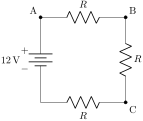
  1. For the circuit in Figure 2.9.1, calculate the voltage at points A, B, and C if (a) A is the common, (b) B is the common, and (c) C is the common.
    Figure 2.9.1.
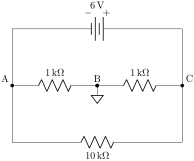
  2. In the circuit shown in Figure 2.9.2, calculate the voltages at points A, B, and C.
    Figure 2.9.2.
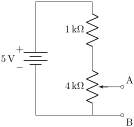
  3. A fixed \(1.0\text{k}\Omega\) resistor and a \(4.0\text{k}\Omega\) potentiometer are connected in series across a 5V battery of negligible internal resistance. Calculate the maximum and minimum values of \(V_{AB}\) based on possible potentiometer settings. (See Subsection 11.5.2 for an explanation of potentiometers.)
    Figure 2.9.3.
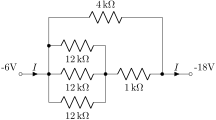
  4. Calculate the current \(I\) in Figure 2.9.4.
    Figure 2.9.4.
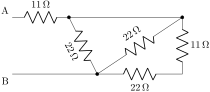
  5. Calculate the equivalent resistance between points A and B in Figure 2.9.5.
    Figure 2.9.5.
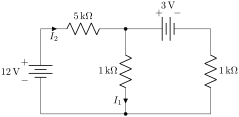
  6. Use the branch method to determine values and directions for \(I_1\) and \(I_2\) in Figure 2.9.6.
    Figure 2.9.6.
  7. Use the mesh method to determine values and directions for \(I_1\text{,}\) \(I_2\text{,}\) and \(I_3\) in Figure 2.9.7.
    Figure 2.9.7.
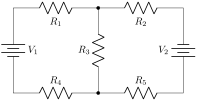
  8. Determine an expression for \(V_2\) that results in zero current through resistor \(R_3\text{.}\) Your \(V_2\) expression may only depend on \(V_1\text{,}\) \(R_1\text{,}\) \(R_2\text{,}\) \(R_3\text{,}\) \(R_4\text{,}\) and \(R_5\text{.}\)
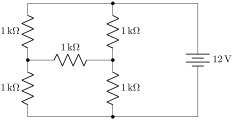
    Figure 2.9.8.
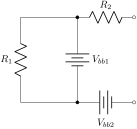
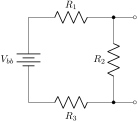
  9. Calculate the Thevenin equivalents for the circuit in Figure 2.9.9.
    Figure 2.9.9.
  10. Calculate the Thevenin equivalents for the circuit in Figure 2.9.10.
    Figure 2.9.10.