Digital circuits are built using a variety of gates that accept digital inputs with values of 0 or 1 and produce a digital output based on a specific gate’s operation. We characterize the behavior of digital gates using truth tables. Figure 7.1.1 shows the digital gates that will be the building blocks for our digital circuits and the truth tables that describe their behaviors.
Take note of the symbols used to represent logic functions in our expressions for output \(Y\) above: the dot ‘\(\cdot\)’ represents AND, ‘\(+\)’ represents OR, ‘\(\oplus\)’ represents XOR, and a bar over a symbol represents NOT. These symbols will be used when we discuss Boolean algebra in the next section. Also note how a circle on a gate output on a circuit symbol above results in the inversion of the original gate output. This circle symbol can be thought of as shorthand for the placement of a NOT gate, and this functionality can be used on any gate port as seen in Figure 7.1.2.
\(A\)
\(B\)
\(\overline{B}\)
\(Y=A + \overline{B}\)
0
0
1
1
0
1
0
0
1
0
1
1
1
1
0
1
Figure7.1.2.A demonstration showing use of a circle symbol in place of a NOT gate for an OR gate input. This gate operates as a standard OR gate for inputs \(A\) and \(\overline{B}\text{.}\)
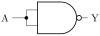
Two of the gate types shown in Figure 7.1.1 hold special prominence. The NAND and NOR gates are known as universal gates, which means that the behavior of any logic function (Buffer, NOT, AND, OR, XOR, NAND, NOR, or XNOR) can be reproduced using a combination of several universal gates of a single type. For example, XNOR functionality can be reproduced solely using NAND gates that are connected together properly. This property causes universal gates to be very popular in circuit design as it allows manufacturers to minimize the number of gate types used in a circuit which can often result in a reduction in manufacturing costs.
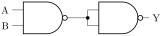
First, note that the right-most NAND gate is in a configuration to replicate the NOT gate according to Example 7.1.3. Thus, the output \(Y\) is just the inverse of the standard NAND output