Section 6.3 Negative Feedback

In the previous section, we saw that operational amplifiers are quite effective at taking sinusoidal \(V_\text{in}\) signals (or any time varying signal) and producing a square wave output according to \(V_\text{out}=\text{sign}\left(V_\text{in}\right)\text{.}\) Based on these examples alone, it may seem like op-amps have limited usefulness.
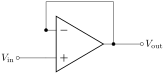
Op-amps are frequently used with negative feedback in which a conducting path is placed between \(V_\text{out}\) and the inverting input \(V_-\) as shown in Figure 6.3.1.
Figure 6.3.1. A circuit employing negative feedback on an op-amp has a conducting path placed that connects \(V_\text{out}\) and the inverting input \(V_-\text{.}\)
We gain the following two golden rules of op-amps that must be satisfied when analyzing circuits containing op-amps with negative feedback:
  1. The output of the op-amp will do whatever it needs to do to ensure that \(V_+ = V_-\text{.}\)
  2. No current flows into or out of the op-amp inputs \(V_+\) and \(V_-\text{,}\) though there may be a lot of current that can flow to or from the op-amp output.
The first golden rule results from the behavior that we examined in the previous section and can be illustrated by looking at three cases, and we’ll assume that \(\left| V_+\right|\lt \left|V_s\right|\) and \(\left| V_-\right|\lt \left|V_s\right|\text{.}\) In case 1, \(V_+ \gt V_-\text{,}\) resulting in \(V_\text{out}=+V_S\text{.}\) Negative feedback would then cause \(V_- = +V_s \gt V_+\text{,}\) switching us from case 1 to case 2. In case 2, \(V_+ \lt V_-\text{,}\) resulting in \(v_\text{out}=-V_s\text{.}\) Negative feedback would then cause \(V_- = -V_s \lt V_+\text{,}\) returning us to case 1. Instead of an unstable output where \(V_\text{out}\) oscillates uncontrollably between \(\pm V_s\text{,}\) the op-amp instead settles into case 3 where \(V_+ = V_-\text{.}\) In reality, there must be a very small difference between the two op-amp inputs, otherwise \(V_\text{out}=0\) would result in case 3. The voltage difference between op-amp inputs in this case will typically be on the order of microvolts and thus will be ignored.
Since \(V_+ = V_-\) for an op-amp with negative feedback, the circuit in Figure 6.3.1 turns out to be a buffer amplifier with voltage gain \(G_V = 1\) since we must have \(V_\text{out}=V_\text{in}\text{.}\) This means that this op-amp circuit provides a benefit similar to that provided by the BJT emitter-follower circuit, except better. There is no voltage drop between \(V_\text{in}\) at the npn base and \(V_\text{out}\) at the npn emitter. Additionally, the input and output impedances of this op-amp circuit are much enhanced over the emitter-follower circuit.

Further examples with negative feedback.

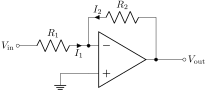
Op-amp circuits with negative feedback can provide voltage gains other than one and infinity through the placement of additional resistors. Let’s analyze the inverting amplifier circuit in Figure 6.3.2 to see how this works.
Figure 6.3.2. This circuit will use negative feedback to produce a voltage gain \(G_V = -R_2/R_1\text{.}\)
Applying the first golden rule, we find that \(V_- = V_+ = 0\text{,}\) meaning \(V_-\) is a virtual ground since the op-amp rules require \(V_- = 0\) Volts but \(V_-\) is not itself connected to the real circuit ground. Next, recognize that
\begin{equation*} I_1 = \frac{V_\text{in}-V_-}{R_1} = \frac{V_\text{in}}{R_1} \end{equation*}
and
\begin{equation*} I_2 = \frac{V_\text{out}-V_-}{R_2} = \frac{V_\text{out}}{R_2}\text{.} \end{equation*}
Since the golden rules require that no current can enter or leave an op-amp input, Kirchhoff’s junction law requires that \(I_1 + I_2 = 0\) or \(I_2 = -I_1\text{.}\) Plugging in our expressions for the currents, we find that
\begin{equation*} \frac{V_\text{out}}{R_2} = -\frac{V_\text{in}}{R_1} \end{equation*}
which results in a voltage gain
\begin{equation*} G_v = \frac{V_\text{out}}{V_\text{in}} = -\frac{R_2}{R_1}\text{.} \end{equation*}
Like the common-emitter amplifier, this circuit applies a negative gain to our input signal, and the magnitude of the gain is dependent on the chosen values of external resistors. This op-amp inverting amplifier does not suffer from the same stability issues as the common-emitter amplifier, and this op-amp circuit maintains much higher input impedance and much lower output impedance than seen with the common-emitter amplifier.

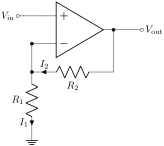
Example 6.3.3. Non-inverting amplifier.

Determine \(G_V\) for the circuit pictured in Figure 6.3.4.
Figure 6.3.4. Non-inverting amplifier.
Solution.
As before, the golden rules require that \(V_+ = V_-\text{.}\) This time, instead of a virtual ground we find that \(V_- = V_\text{in}\text{.}\) Since no current can enter/leave the op-amp inputs, we must have \(I_1 = I_2\text{.}\) Using Ohm’s law,
\begin{equation*} I_1 = V_\text{in}/R_1 \end{equation*}
so that
\begin{equation*} V_\text{out} - V_\text{in} = I_1 R_2\text{.} \end{equation*}
Combining these results,
\begin{equation*} V_\text{out} = V_\text{in} + \frac{R_2}{R_1} V_\text{in} = \left(1+\frac{R_2}{R_1}\right) V_\text{in}\text{.} \end{equation*}
Thus, the voltage gain for this circuit is given by
\begin{equation*} G_V = 1+\frac{R_2}{R_1}\text{.} \end{equation*}
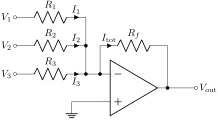
Example 6.3.5. Weighted summing amplifier.

Determine \(V_\text{out}\) for the circuit pictured in Figure 6.3.6.
Figure 6.3.6. Weighted summing amplifier.
Solution.
The golden rules require that \(V_+ = V_-\text{,}\) meaning that \(V_+\) is grounded and \(V_-\) is a virtual ground. We can then use Ohm’s law three times to find
\begin{equation*} I_1 = \frac{V_1}{R_1},\qquad I_2 = \frac{V_2}{R_2},\qquad I_3 = \frac{V_3}{R_3}\text{.} \end{equation*}
When Kirchhoff’s junction law is applied at the \(V_-\) junction, we find
\begin{align*} I_\text{tot} \amp = I_1 + I_2 + I_3 \\ \amp = \frac{V_1}{R_1} + \frac{V_2}{R_2} + \frac{V_3}{R_3} \text{.} \end{align*}
Since \(V_- = 0\text{,}\) one further application of Ohm’s law gives
\begin{align*} V_\text{out} - \cancelto{0}{V_-} \amp = -I_\text{tot} R_f\\ \amp = -R_f \left(\frac{V_1}{R_1} + \frac{V_2}{R_2} + \frac{V_3}{R_3}\right) \end{align*}
based on the chosen \(I_\text{tot}\) direction in Figure 6.3.6. In the special case where \(R_1 = R_2 = R_3\text{,}\) this results in
\begin{equation*} V_\text{out} = -\frac{R_f}{R_1}\left(V_1 + V_2 + V_3\right)\text{.} \end{equation*}

Example 6.3.7. Differentiator.

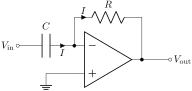
Determine the behavior of \(V_\text{out}\) for the circuit pictured in Figure 6.3.8.
Figure 6.3.8. Differentiator.
Solution.
We find that \(V_-\) is a virtual ground since \(V_+\) is connected to ground. Also, the currents through the capacitor and resistor are identical since no current can enter/leave the op-amp inputs.
We have seen in introductory physics that \(\Delta V_C = Q/C\) where \(\Delta V_C = V_\text{in}-V_-\text{.}\) Therefore, \(V_\text{in}=Q/C\text{.}\) We can use Ohm’s law to show \(0-V_\text{out}=IR\text{.}\) In introductory physics, we also learned that \(I=\text{d}Q/\text{d}t\text{.}\) Combining these expressions, we find that
\begin{equation*} I=C\frac{\text{d}V_\text{in}}{\text{d}t} \end{equation*}
and thus
\begin{equation*} V_\text{out} = -RC\frac{\text{d}V_\text{in}}{\text{d}t}\text{.} \end{equation*}
This result reveals this circuit’s ability to produce an output voltage \(V_\text{out}\) that is a constant multiplying the time derivative of \(V_\text{in}\text{.}\)
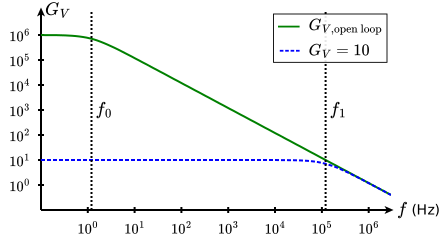
INSERT A NOTE DISTINGUISHING BETWEEN OPEN-LOOP GAIN AND CLOSED-LOOP GAIN (FROM NEGATIVE FEEDBACK)