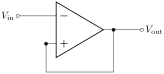
The next external modification we’ll examine is the application of positive feedback to op-amps. When positive feedback is applied to an op-amp, a conducting path is placed between \(V_\text{out}\) and the non-inverting input \(V_+\) as shown in Figure 6.4.1.
Figure6.4.1.A circuit employing positive feedback on an op-amp has a conducting path placed that connects \(V_\text{out}\) and the inverting input \(V_-\text{.}\)
In this configuration, any difference between the input voltages causes \(V_\text{out}\) to ‘latch’, at either the positive or negative output state . This is an example of hysteresis, meaning that the circuit responds to some change at the inputs but then fails to return to the original output state when the inputs return to their original states.
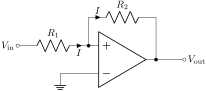
We can modify the above hysteresis behavior by introducing resistors into our positive-feedback circuit in a configuration called a Schmitt trigger. The Schmitt trigger circuit is shown in Figure 6.4.2.
Figure6.4.2.A Schmitt trigger circuit, employing an op-amp with positive feedback.
In this circuit, \(V_-\) is connected to ground resulting in a virtual ground at \(V_+\text{.}\) Since current cannot flow into or out of the op-amp inputs, the same current \(I\) must be passing through each of \(R_1\) and \(R_2\text{.}\) An application of Ohm’s law across the two series resistors gives
Since op-amp behavior will cause \(V_\text{out}\) to depend directly on \(V_+\text{,}\) let’s find an expression for this parameter. Using Ohm’s law on \(R_1\text{,}\) we find that
Now, the state of \(V_\text{out}\) will be \(+V_s\) or \(-V_s\) depending on whether \(V_+ \gt 0\) or \(V_+ \lt 0\) with the transition occurring at any crossing of \(V_+ = 0\text{.}\) We can use our \(V_+\) expression above to re-express in terms of \(V_\text{in}\) the condition for changing the state of \(V_\text{out}\text{.}\) After a little algebra, we find that this new condition is given by
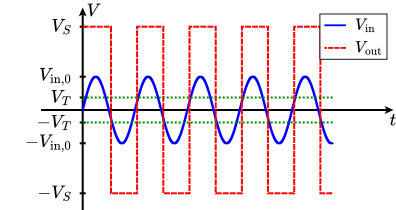
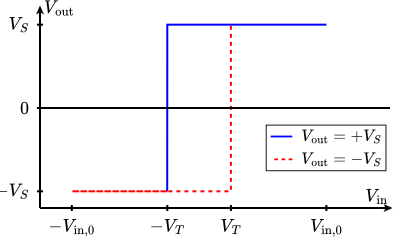
So, if \(V_\text{out}=+V_S\) initially, then the output state will only change once \(V_\text{in}\) crosses the threshold voltage \(-\frac{R_1}{R_2} V_S = -V_T\text{.}\) Likewise, if in some second time period we find \(V_\text{out}=-V_S\) initially, the output state will only change once \(V_\text{in}\) crosses the threshold voltage \(+ \frac{R_1}{R_2} V_S = +V_T\text{.}\) Combined, \(V_\text{out}\) changes from \(\mp V_S \rightarrow \pm V_S\) when \(V_\text{in}=\pm V_T\)
Figure6.4.3.This plot shows the response of \(V_\text{out}\) based on when \(V_\text{in}\) satisfies the necessary condition related to the threshold voltages \(\pm V_T\text{.}\)
Figure6.4.4.The hysteresis associated with the Schmitt trigger is demonstrated more clearly in a plot of \(V_\text{out}\) vs \(V_\text{in}\text{.}\) The value of \(V_\text{out}\) in the region \(-V_T \lt V_\text{in} \lt +V_T\) is dependent on the output state at the previous time point.