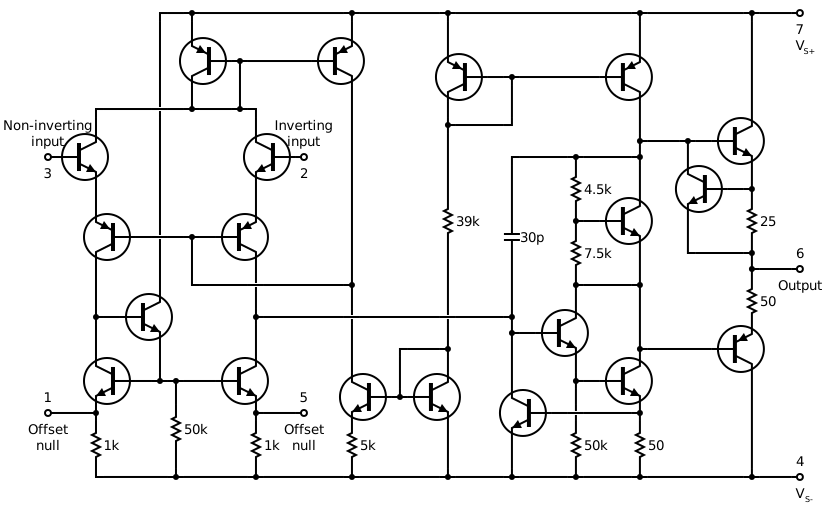
The operational amplifier is an integrated circuit that has been designed to act as a voltage amplifier. The 741 op-amp was one of the first low-cost, high-performance, general-purpose operational amplifiers. Figure 6.1.1 shows a circuit schematic for the 741 op-amp, revealing 24 transistors, 11 resistors, and one capacitor.
Figure6.1.1.A schematic diagram showing the voltage amplifier circuit design for the general-purpose 741 op-amp. (Source: User Omegatron, 741 op-amp schematic, October 2011, Wikimedia Commons. Public Domain.)
The smallest 741 op-amp chips are manufactured using the SOIC-8 package which measures approximately 4mm\(\times\)5mm\(\times\)1.75mm, though other more modern models can be as small as 0.88mm\(\times\)0.58mm\(\times\)0.33mm.[TEMP LINK] A look at the internal layout of a real physical 741 op-amp can be seen in this linked blog post, which also provides an interactive chip viewer that allows the reader to view the op-amp chip’s physical layout and click on physical components to have the corresponding element in the circuit schematic highlighted. This image shows that the sole capacitor occupies a rather large percentage of the chip’s area.
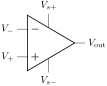
In circuit schematics, the ideal op-amp is represented by the symbol shown in Figure 6.1.2, where \(V_-\) and \(V_+\) are called the inverting input and non-inverting input respectively. The amplifier output is given as \(V_\text{out}\text{.}\) Op-amps are active circuit components and require external voltage sources for operation, just as transistors require \(V_{CC}\) and \(V_{EE}\) as supply voltages. These two supply voltages are marked as \(V_{s+}\) and \(V_{s-}\text{,}\) though these connections are sometimes left out in circuit diagrams.
Figure6.1.2.Schematic symbol for an ideal op-amp. The inverting and non-inverting inputs are specified as \(V_-\) and \(V_+\text{.}\) The two voltages \(V_{s+}\) and \(V_{s-}\) are supplied by an external power source.
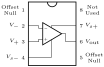
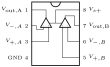
Figure 6.1.3 shows a top-view pin diagram for two general-purpose op-amps. The half-moon shape allows one to identify pin 1, with remaining pins being counted in a counter-clockwise manner.
Figure6.1.3.Sample top-view pin diagrams for two general-purpose op-amp chips, the LM741 and the LM358. This particular pin diagram is specific to the general purpose LM741 op-amp chip. Other op-amp chips may have different pin diagrams.